Showing posts with label Cooking School. Show all posts

Saturday, August 1, 2026

Part XVIII: Prepping for Success

One of the things I'm looking forward to in retirement is not stressing about wanting to eat dinner the minute I come home.  I'll be able to do a 2-3 hour cooking project any day I choose.  Since I'm not there yet, I'm reluctantly getting into banking my own freezer meals.  One bacon western cheeseburger is a fun treat after a hard day.  More than one after-work drive thru in a month is a cry for help.

I already do this with baked goods.  It started with making four half-pound loaves out of a batch of challah dough and freezing them until needed.  It has gotten to the point that up to half of the chest freezer at any given time is bread, cookies, or another baked product.

It doesn't take much time or money to make your own freezer meals.  Whatever you're making, double it and freeze the rest.  This works great for lasagna, casseroles, and stews.  Buy the larger piece of meat if there's a sale, cook all of it, and slice the leftovers for another use.  Make that double batch of cookies or brownies and freeze what you don't need yet.  Cook up a whole pound of dry beans and freeze the result in 2-cup (one can) baggies.  If you keep an inventory taped to the freezer, items won't languish.  Just remember to update it whenever you add or remove items, or you could end up short one meal.

Yes, I know many people don't have a chest freezer.  The trick is to make the space you do have work for you.  Turn the little half-bags falling out every time you open it into something.  Rotate so nothing is freezer-burned.  If something is in there longer than six months, ask yourself why.  (For me, that's nuts and a bag of cranberries.  Nuts are a given since that's the best place to store them, but I really do need to use the cranberries.)

Most recently, I threw too many veggies into a teriyaki stir fry.  It ended up being five servings, so I was able to freeze the rest.  Another day, I grilled a whole tri-tip roast.  A pound was left after four servings, so that is in Freezer Camp for a month or two.

I haven't yet dedicated a day to intentionally making freezer meals.  Haven't had time for it.  When I do, that will be shared.  It's also a way to get ahead of holiday cooking.  Six weeks until Rosh Hashanah.

Saturday, July 11, 2026

Freezing Eggs

I don't know what made me think I could go through 40 eggs in a month.  The sale was two 20-packs for $4, or 10¢ each.  I'm still paranoid about egg prices since the bird flu shortage.  I tried baking and adding them to other dishes, but I only have breakfast at home 4-5 days per week.  Plus, I was about to go on vacation for a week.  It was time to look for other ways of preserving them.

You can't freeze hard-boiled eggs.  It turns the whites into water.  You can dehydrate yolks, and the new dehydrator came with a recipe.  You salt-cure them first, then dry into something similar to a cheese that is then grated.  Not something I'm interested in.  That left freezing them uncooked.

You can freeze the yolks and whites of raw eggs separately.  The whites will not be usable for meringues, but you can scramble them up.  The yolks will still have their thickening power.  The majority of the eggs I use are for omelets and whole in baked goods, so I went the scrambled route.

The process is very easy.  Crack into a bowl and scramble.  You can add a pinch of salt and/or pepper to make seasoned eggs.  Not knowing the final use, I opted for plain.  Pour the egg into ice cube trays or silicone muffin cups.  Freeze, pop out, repeat until you've made as many as you want.

The frozen eggs can then be transferred to a freezer bag or other container and kept frozen.  To use, bring out desired number and thaw overnight in the fridge.  Scramble them back up to redistribute the water content and you're good to go.  The bags will be a loss, as I don't reuse plastic bags that have held foods requiring cooking.  I could have used the FoodSaver, but I wanted to be able to store many in one bag and pull out one or two as needed.

I'm not going to do this all the time, but it was a solution to the problem on this day.  It turns the eggs into a long-term food item, with a storage time of up to three months.  And I will watch my urge to get a good deal in the future.

Monday, May 18, 2026

Two New Grocery Stores

I have been having a terrible time finding chickpea flour, and I prefer not to order food from Amazon.  Yes, I know it's safe, but I don't trust the packages not to break in transit.  So I searched for Indian grocery stores on my way home from work one day.  It was more of a detour than I expected, and I was not really in the mood to shop, but I got my chickpea (besan) flour for a better price than I was expecting.

What had not occurred to me was all the other things I would find at the market.  Of the two aisles in the shop, half of one was giant bags of spices and blends, like a pound or more each.  There were teas, 25 pound bags of atta flour and rice, every Indian legume you can imagine, and quite a few other things I didn't pay attention to because I was there for one item.  They didn't have as much produce as I was expecting, but they did have those cute egg-sized eggplants I like.

I forgot to take photos, and I'm not going to go back without a shopping list and much more energy.  Not the store's fault.

The other new store I tried was a supermarket that just opened near me.  With grocery prices these days, I have stopped being loyal to one store and go where prices and products match my list.  Although, I did just win a $50 Albertsons gift card from one of their promotions; loyalty rewards can pay off.  Super King is a local chain with only a few stores.  This is the first within shopping distance.  Off their ad, I saw cherries for $1.29/lb and butter for $2.  I figured I'd scope out the place and pick up $5 of groceries.

It's a wonderfully open floorplan, with half of the space devoted to fresh produce.  The cherries were terrible, so I passed them up, and they were out of the cheap butter.  I still spent $18.

So this is now a haul post.  For fresh produce, I got two Persian cucumbers and a bunch of radishes to make a quick-pickle salad to have on taco night.  Total for that was 73¢.  They had decent strawberries for $2 a pound that I got instead of the cherries.  They also had the baby eggplants, but I didn't have a plan for them and let them be.  I figured I was done, but kept walking around.

I had been under the impression that Super King was kind of like a Sprouts that catered to a partially Hispanic market.  Not at all.  Yes, there are south of the border foods, but I'd say close to half of the inventory specializes in Mediterranean, Middle Eastern, and South Asian groceries.  That means I don't have to trek to Westwood anymore.  I found four brands of frozen fava beans, the ones I had been looking for in March.  Got one package.  I did not get the frozen parathas.  Still trying to decide if I want to attempt to make them.  There was also a monthly special on store brand avocado and olive oils.  I've never bought avocado oil, simply because it's expensive.  $6 each for 750ml bottles.

I would call both shopping expeditions successes.  I learned about myself and what I would like to have in my pantry.  Passing up an ingredient is just as important as what you buy.  And if I see an unusual ingredient in a recipe, I now know where to find it.

Wednesday, February 11, 2026

Rendering Fats

When I canned up some roasts last week, I had a small pile of fat that it seemed a shame to throw away.  I paid for it by weight, after all.  I've never done this before, but I decided to render them down to save as cooking fats.  Beef suet and pork lard are traditionally from the fat around the liver and kidneys, not muscular fat, but it still works.

I got out the small Crockpot and a saucepan, to try two methods.  The pork trimmings went in the Crockpot on low while all the canning was going on plus a while after, maybe 6 hours.  The beef went on the stove at the lowest flame for about three hours.  I poked each every hour or so, to get the more fatty pieces closer to the heat.

When I strained them off into containers, I had about a quarter cup of each.  Not as much as I was expecting.  Maybe I could have rendered them longer, but the beef at least looked done.  The liquid is yellow, and cools to a white.  It is best stored in the fridge unless you can be 100% sure there are no impurities in it.

I was still a fun experiment, and I'll use it.  Was it worth the gas and electricity?  Probably not.  But now I can do some UK recipes I've seen that use suet.  I don't think I've ever seen it for sale.   You can buy lard at an American market.

Wednesday, December 31, 2025

Pantry Challenge Game Plan

Tomorrow is 2026!  Wow, how did that happen?

I feel like I'm not going through my pantry in the proper amount of time, so I'm doing Pantry Challenge January.  It's a chance to use items before they go bad and challenge myself to come up with new uses.  It saves money when all the December bills come due by using what you've already bought.  You can evaluate why an ingredient is languishing while others seem to run out, and adjust what you stock accordingly.

The big rule is that you set your own rules.  The ultimate goal would be not setting foot in the grocery store for a month, but that is not necessary.  I have a list of items I'm permitting myself to buy, generally highly perishable ones.  Can't keep bananas fresh for 31 days.  Any recipe I make should have as few new purchases as possible.  If there's an exceptional deal on something I know I'll use, like toilet paper or coffee, I can stock those and not count them as current grocery purchases.

In particular, I need to do something about the kitchen freezer.  It's where I keep my vegetables and a few other items.  All the stray bits and leftovers are crowding out what I prefer to keep in there.  Also, I need to have room in it for the chest freezer defrost in March.  Because I'm already thinking about that.

The last time I tracked my spending during a pantry challenge, I stayed under $50 for the month.  That was 2022, so I'm not holding out for the same result.  At some point, I'm bound to celebrate the extra room in the freezer by filling it with ice cream.

What I'm focusing on isn't simply reducing the quantity of an item in the pantry or freezer.  I want to use the oldest items and anything "best by" the first half of 2026.  I want to reduce the condiments in the fridge.  The kimchi is almost a year old.  So are the cranberries in the freezer.  This is about rotating through ingredients and deciding whether I want to buy them again.  Maybe I'll remember I love something I've been passing over and incorporate it more.

The real trick is to continue coming up with new recipes.  Can't have peanut butter pasta every night, as tempting as that may be.  If I do this right, you'll never notice that I'm only using items on hand and from the garden.

Friday, May 2, 2025

Pantry Inventory

We're doing a section topic post.

No one likes to do inventory.  Not at work, and not at home.  After the recent Southern California fires, I went around the house and took pictures, in case I ever need to itemize for insurance purposes.  Probably will never happen, but everyone should have some idea of what they own.

Kitchen inventory, for me, gets done before Passover.  Once a year is generally all you need, assuming fresh foods are rotated before they get scary.  Frozen and dry storage commonly are designed to last between a year to 18 months.  A few items, like whole wheat flour and brown rice, tend to spoil after only six months if you live in a warm and/or humid climate.  Canned meats are often dated as long as five years.

I don't write down what's in the dry pantry.  I just keep it neat and avoid stacking things that are not alike.  The fridge is not crammed full, so I can see everything.  The chest freezer, on the other hand, gets a post-it list.  I only itemize the meat, though I should probably write down the mini pie shells I've had in there since December.  I was going to do thumbprint mince pies and never got around to them.  Some people with cellars or exceptionally large pantries do make a written inventory or computer spreadsheet of everything, and their best-by dates.

When I was clearing one shelf at a time to do the Passover sorting, I realized that I have a LOT of food in there.  It's the beans.  I count them as shelf-stable proteins and have more of a variety of them than of meats.  A pound of dry beans is roughly 12-14 servings, so a pound each of 8 or more legumes is about a four month supply if I suddenly went vegan.  Well, less if I was also using them for breakfast and lunch.  In addition to the dry beans, I have over a dozen cans and jars ready to use, at 3-4 servings each.  But there were no surprises, no spoiled foods, nothing I had forgotten, and I could remember why I had bought everything.

It's a good idea to look through what you have on hand when meal planning or making a grocery list.  It prevents over-buying or forgetting an item until it is no longer good to eat.  For me, it can spark creativity or a new recipe.  And these days, whatever you spent on the food you have on hand is less than what it is going for now.

Thursday, March 27, 2025

Part XVI: The Frugal Pantry

I haven't changed topics in a couple of years, mainly because I'm still focusing on lower-carb, Mediterranean-style dishes.  There are so many out there, from over a dozen cultures, and I've barely scratched the surface.

Still, I've noticed an evolution in my tactics related to the economic times we live in.  I've also been rereading the Little House books.  I read them every ten to fifteen years, and get something different out of them every time.  This time, I appreciate the homesteading aspect and how scary it must have been when you couldn't rely on a fully stocked grocery store.  We all faced that for a few months in 2020, and North America is on the verge of that again.

As a single-person household, what I purchase lasts far longer than it would for a large family.  The principles I use to stock what I need are the same as someone who manages a household of 10.  Just far less of it.  I also may keep very different items than some others, based on what I like and dietary needs.

In this section, I'll go into the elements of food storage and creative ways to use pantry staples.  There will be ways to use less expensive ingredients in fancy-looking dishes and how to use the sales to stock items you know you will go through.  I'm constantly learning new tricks and figuring out how much I actually use.

Again, this is what works for me.  I don't feel like I can go back to the four day supply of groceries I kept pre-pandemic.  Planning meals a month ahead seems to be how I personally feel I can best take advantage of sales and product availability.  It won't be the same for everybody.  My pantry is large enough for a family of 4-6, so carrying that much inventory of non-perishables is easy.  The fridge is rarely more than half full, and I've been working on the freezer ahead of the annual defrost.  I had too much meat in there anyway, for someone who eats vegetarian half the time.  But that's another post.


Wednesday, January 29, 2025

New Ingredient: Egg Replacer


Assuming you can get eggs at all right now, they're twice as much as I'm willing to pay.  I'm investigating my options, as I eat a lot of them.  Looking into different breakfast proteins as well, and not ruling out tofu or other vegan options.  For baking, I decided to try a bag of Bob's Red Mill egg replacer.

I read the ingredients before buying it, because if it was mostly chia it would do crazy things to my stomach.  There's a reason I don't do chia "eggs" or pudding.  It's the binders tapioca flour, potato starch, and psyllium husk, with some baking soda to mimic the leavening of eggs.  It's gluten free, egg free, and vegan.

It's also a nutritional black hole.  I consider eggs a protein and fat, even in baked goods.  This is a couple of carbs without fiber, and that's about it.  Ok, fine, I'll consider it for its binding properties and not use it in challah, where eggs are for flavor and fat.

The first thing I tried with it was waffles, since they're fairly forgiving.  I feel like they could have risen better, but the taste was right.  They weren't tough, like they would be if there was no egg and the gluten was the only thing holding them together.

Next up was subbing for the egg in lasagna.  Granted, the egg doesn't really do much except keep the ricotta from running everywhere, and I don't think that's a problem.  I definitely noticed the thickening effect in the ricotta.  I had put in a lot of water, to make it easier to spread, and by the time I got to it the mixture had thickened up almost to where I started.  Also, I made way too much filling, so I made a second 8x8 for the freezer.  That's going to come in handy some day I don't want to cook.

I haven't tried it yet, but a good off-label use would be to make stabilized whipped cream.  I've struggled with ways to make it work.  The package does not say it requires cooking before consumption.  Adding it directly to the cream before whipping might do the trick.

Will I buy this again?  Hard to say.  I do like the idea of shelf-stable options for commonly used ingredients.  It reduces the odds of going to the market for one thing, which never turns into only one thing.  And if this saves an egg that's only there to hold something like crepes together, it's worth $5 for a three dozen equivalent package.

Sunday, January 26, 2025

Bagel Chips

I have had two sesame bagels in the freezer for so long, I don't remember why I saved them.  It may have been for tashlich, before they put out a request to bring vegetables instead of bread because it's more environmentally friendly and safer for the birds.  Either that, or for a stuffing I never made.  I also remember thinking I could make breadcrumbs out of them.

Turning stale bread into croutons or chips is very easy.  You just toss or brush the cut slices with oil and toast them in the oven with whatever seasoning you choose to sprinkle on them.  That is, until you try to multitask a pie, don't set a timer, and leave them in about three minutes too long.  These were edible, just quite a bit darker than I had in mind.

1 or 2 day-old bagels
olive oil
seasonings of choice: flake salt, everything seasoning, Italian herbs, etc

1.  Preheat oven to 350º or 325º with convection.  Line a baking sheet with parchment or a silicone mat.

2.  Slice bagel thinly, ideally a quarter inch thick or less, all around the radius.  You can do them the long way too, if you want ovals instead of rounds.

3.  Lightly brush both cut sides with olive oil.  You're looking for a drop or two on each, maybe a total of 2 Tb for this entire project.  Sprinkle with seasonings, if using.  I left mine plain because they were already sesame.

4.  Bake chips 10 minutes, flip, and bake another 10 minutes or until crispy and about three shades less brown than the ones I made.  Allow to cool and set, then serve with soup, salad, or dips.

Yield depends on size and number of bagels

Difficulty level  Ï€

Friday, November 15, 2024

New Kitchen Gadget

I didn't really need another kitchen toy, but there were some really good sales everywhere to counter October's Amazon Prime Days.  I'm calling it an early Chanukah present to myself.

I bought a 7 qt Crockpot.  I love my little 1.5 qt, but a lot of the things I try to put in it are too big.  I was going to ask for a bigger one for a holiday gift, until Target ran a brand sale of 20-25% off.  I considered the 4.5 qt, which was only $20 that week and came in a couple of fun colors.  Then I realized that I would eventually get the big one and skipped right to it.  $32 on sale, plus I had a $5 coupon from getting a flu shot.

As you can see from the box, you can cook a whole chicken dinner in it.  At some point, I probably will, or maybe an 8-10 lb turkey.  I'm already planning to use it for the brisket.  Ooh, I bet a leg of lamb would fit.  Also, large batches of broth for canning and pots of soup that I don't want to leave on the burner for hours.  The insert comes out, to take along to pot lucks.  As you can tell, I've thought about this a lot.

I put it back in the box, and I'm going to try not to use it until Chrismukah.  If I need it to cook for a party, then it will come out earlier.  It's amazing that I've gone from being scared of leaving the little one alone to this.  I'm also not scared of the pressure canner anymore.  It's nice to be able to trust basic technologies that have been around for decades.

Saturday, July 27, 2024

Canning Asparagus

Most people start their pressure canning journey with broth, maybe beans, or raw-pack meat if they're feeling adventurous.  I went for the one item a lot of people warn against canning because you might not like it, asparagus.  I actually love canned asparagus, but it's so different from freshly steamed or roasted that it's like a whole different vegetable.  You should not go into this experience without trying store-bought canned asparagus first.

I went with this for a few reasons.  First, it was probably the last good sale of the year.  Second, I don't have any in the pantry, and I do have some of the other items on my to-can list.  And third, it's just hot-pack produce, which is how I prefer to do my fruits, and I'm used to that procedure.

Once I got the four pounds of asparagus opened and in the sink to wash, I was disappointed.  This was not the greatest quality asparagus.  Most of the ones in the store were too thin to can, so this is what I was stuck with if I didn't want to wait nine months to do this project.  An appalling amount ended up in the compost bucket, including whole spears that were unusable.  I had hoped to get six pints out of the purchase, and heated up eight jars, but only ended up with 5.  Still, five cans at the market cost considerably more than the $10 I spent, including lids, so it's a deal.

I'm not going to post a recipe, since it's the procedure in the Presto manual, Ball Book, NCHFP website, and every reliable and up-to-date canning source.  Basically, you blanch the prepared stems, put them in jars with 1" headspace, fill with cooking liquid or boiling water, add salt if desired, and do all the good stuff related to lids before putting it in the canner.  Process at the right pressure for your elevation 30 minutes for pints and I forget what for quarts because that is way more canned asparagus than I will ever need at once.

The jar with only stems and no tips - the one I expected to use for cream of asparagus soup - didn't seal.  I could tell right away because the pieces weren't floating like in the other 4 jars.  It probably siphoned slightly, based on the smell, and particles prevented the seal.  It happens.

This brings up the good point that you should always have a plan when you're canning for what you'll do with any failed seals.  I had some of the unsealed jar in my vegetable medley the next couple of nights, and the rest over the course of the week.  It gave me a chance to try it before putting away all the jars, which was a plus.  It tastes like canned asparagus, and that was the goal.  I could have put in a little more salt.  The recommended amount is 1/2 tsp and I used 1/8.  Maybe I'll try 1/4 next time.  It was close.

So, what do I think about pressure canning?  It does take half a day to process a load of something, but now I'm set for months.  I rotate my ingredients, not using much of any item in a given month, so I might not open the next jar until after summer.  Hot pack did take far less time than the raw pack method I practiced with, because the boiling time is cut drastically.  The canner will get used, but mainly when there's a good deal on something I use enough to make 8-9 pints of it.  And that was my justification for this purchase in the first place.

Monday, July 15, 2024

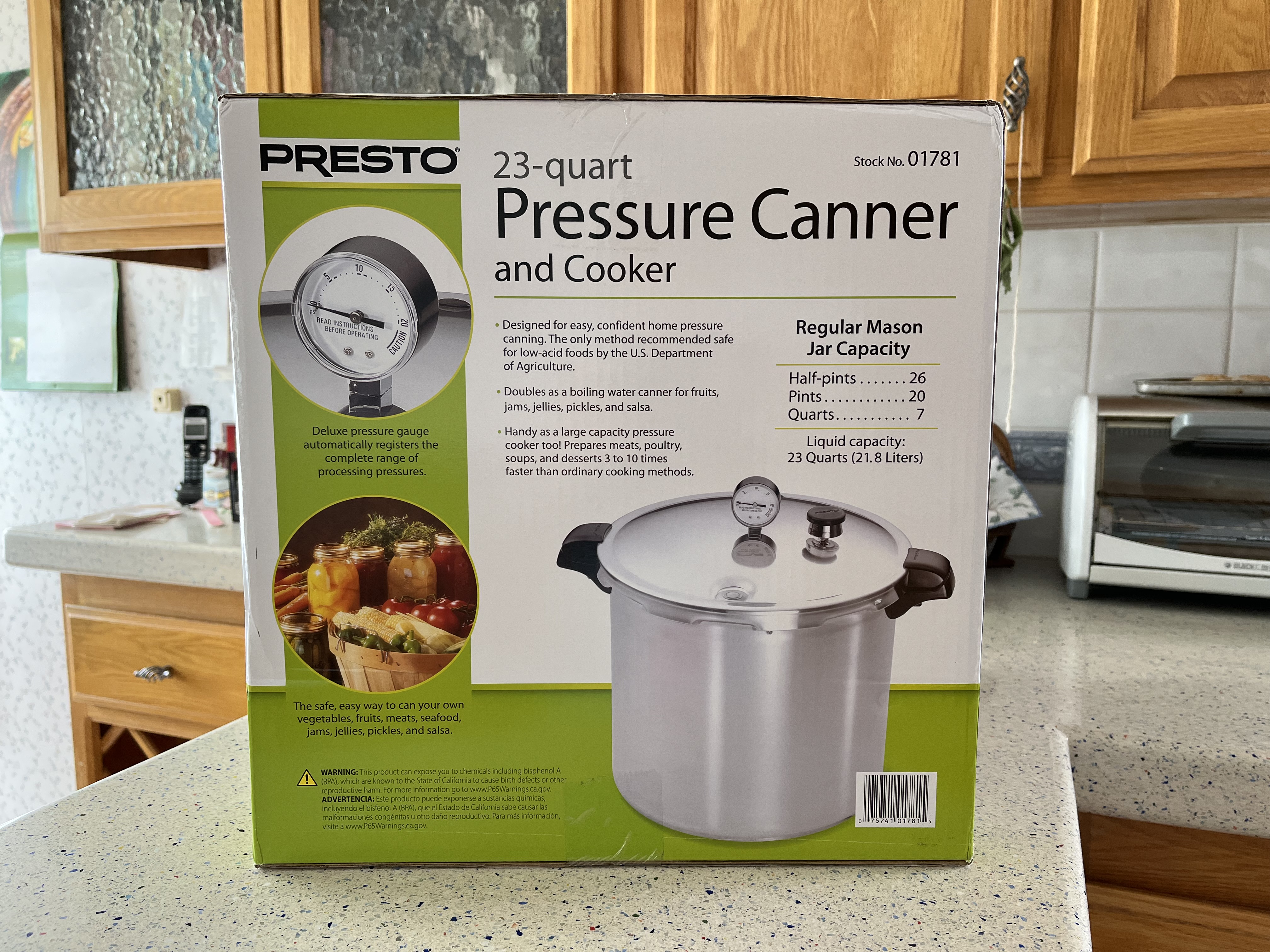
I Bought a Pressure Canner

I have been considering whether I want to start pressure canning for a couple of years.  Many of the people I follow on social media do it.  I've been doing water bath items for almost two decades, but have been scared of the botulism risk involved in low-acid pressure canning, not to mention the whole pressure cooker thing.

The boneless-skinless chicken in my freezer was part of what put me over the edge.  If I didn't have to cook it up before having it to use in lunches and casseroles, I would eat it a lot more and not let it languish in the deep freeze.  I would use canned meats far more if I could control the salt and spices in them and they didn't cost so much to replace.  I also miss having canned soups, but very few fit my current eating lifestyle and all of them have too much salt.

I also considered if it was really worth canning items as a convenience if I'm using the Crockpot more.  But I prefer chicken thighs in the slow cooker and breast in canned.  I generally don't make beans in the slow cooker unless it's a recipe that takes at least 4 hours in the oven.  Most of the time, I want skins on my potatoes, and you have to peel them before canning so I probably won't do that.  There are just a lot of differences in what I would put in a jar on the shelf and what I would come home to in the Crockpot.

It also does more than just pressure can jars.  It's a pressure cooker, if I ever want to cook up 10 lbs of pork butt for a luau or an entire brisket.  I could use it to make the broth that I will later be canning.  It's a giant stock pot and can be used as a steamer.  With the extra racks I ordered, I could make three layers of tamales and feed everyone I know.

I spent a week doing a cost/benefit analysis.  Not everything is cheaper home-canned.  There's the price of the ingredients plus 40¢ or so for the lid.  (I did combine a sale and a gift card to order lids for what ended up being 14¢ apiece for a couple of years' worth.)  Just because some things are can-able doesn't mean I like them that way, like green beans and peas.  There's the initial cost outlay for jars and equipment, some of which I already have from water bath canning.  I'm estimating a 2-year break even point, which is far sooner than I had originally expected.  A lot of that is in broth, which is basically just the cost of the lid because the rest of it is stuff you throw away, like bones and veggie trimmings.  A well-maintained canner and jars can last nearly forever, so these are one-time purchases.

What made me go for it right now was a really good sale combined with far more Amazon rewards than I realized I had from my credit card.  It wasn't free, but it was pretty close.

This blog is not going to become all about canning.  I'm not starting a new chapter.  I will share my experiences just as I would any recipe I'm trying for the first time, then move on.  I don't post every time I water-bath can, only when the recipe is interesting and not a repeat.  I only expect to can about once a month anyway.  Seriously, a 9-pint load of anything will last me quite some time, and you really shouldn't put up more than a year's worth of any one item, same as water bath canning.  I will still refer to a "can" of something as a grocery store item, as a can of tomatoes or beans is the same yield as a pint jar.

The first step was reading the manual a few times and running a load of water only up to 15 pounds of pressure to find out if the dial gauge is accurate.  It isn't part of the instructions, but it should be.  The factory 15-pound jiggler, to be used for pressure cooking, starts to rock at 14 on the dial, so I know that the gauge is one pound low.  Canning at sea level is 10-11 pounds, and I now know to err closer to 10 until I buy a 10-pound weight.  No idea why canners don't come with them.  I think ForJars is the only brand that comes with multiple weights for different elevations.

The second step was to run water-filled pint jars through it, to get used to the process and how long it takes.  Raw pack, I'm looking at about two and a half to three hours per load.  That's over half an hour to get it boiling, ten to vent, another ten-ish to get to pressure, the actual processing time, half an hour for pressure to drop, and ten with the regulator off for everything to normalize.   And you have to watch it every couple of minutes, so you’re in the kitchen pretty much the whole time.  On the other hand, I was practicing with reused lids, and they all sealed.  That's a pretty impressive rate when I'm doing everything right with actual ingredients and new lids.

Sunday, June 30, 2024

Whole Wheat Bread

For those who missed it, I'm fed up with the price of bread and have decided to make my own.  One bag of wheat flour costs the same as a loaf, and will last me at least half a year at the rate I eat sliced bread.  Yes, there are more ingredients than just the flour, but I can still make a loaf for under $1, probably closer to 50¢.

If I already have a basic whole wheat loaf on this blog, it is hidden so well even I can't find it.  So, I went back to the Bible for a starting point and altered it a touch for a single loaf and my personal tastes.

One thing to keep in mind is that whole wheat bread generally has part white flour.  Otherwise, it would be a very rustic and tough loaf.  Maybe I'll tackle whole grain bread at some point, which is usually all whole wheat flour with various grains in it to cut the density.  Wheat bran has fat in it, which shortens gluten strands and produces a more dense loaf.  It will take more liquid to make a loaf than an all white one and it will weigh more by volume.  Not a lot more, but if you weighed white and wheat loaves side by side, you would see the difference.

I chose to use bread flour here, but all-purpose would be fine if that's all you have.  It may take slightly more of it to achieve the desired texture because of the way different flours absorb moisture.

1 C 100º milk (or water for a leaner loaf)
1 Tb honey
1 Tb brown sugar
2 Tb unsalted butter
2 tsp yeast
2 C whole wheat flour
1 C bread flour
1-1/2 tsp kosher salt

1.  Stir together milk, honey, sugar, butter, and yeast and let sit until foamy, about 5 minutes.  The butter does not need to melt.

2.  In stand mixer with paddle, combine whole wheat flour and milk mixture.  Yes, I know the dough hook is more appropriate, but I have better luck with the paddle for small batches.  Beat on medium-low setting for 2 minutes.  Or, by hand in a bowl with a spoon.  You'll just end up kneading it longer.

3.  Add 1/2 C bread flour and salt.  Beat again until well combined and pulls away from sides of bowl.

4.  Transfer dough onto work surface dusted with bread flour.  Knead until smooth, 5-10 minutes.  This dough will feel denser than a white dough and won't stick to the board.  Shape into a ball.  Turn over in a lightly oiled bowl, cover, and set in a warm place to rise until doubled, about 1 hour.

5.  Punch down dough and let rest 10 minutes, while you prepare the loaf pan.  Either grease with shortening, pan spray, or line with parchment paper.  If you have a silicone one, great, you can skip that step.

6.  Roll out dough into a 9" x 12" rectangle.  Roll up into a 9" log.  Tuck the ends under and place, seam side down, in the loaf pan.  Allow to rise again for 45 minutes, until the loaf fills the pan and is well-risen on top.

7.  Preheat oven to 400º.  If you want a butter-top loaf, brush top crust with melted butter and split down the middle.  (I don't think I'm going to split them anymore, unless I get one of those lame blades.  It tore the "skin" and made it rise unevenly.)  Bake 30-35 minutes, until golden and sounds hollow when tapped.  Remove at once to a cooling rack so the bottom doesn't get soggy.  Cool completely before slicing so the loaf holds its shape.

Makes one loaf, about 10 servings

Difficulty rating  :-0 if you aren't used to making bread, otherwise :) for the time investment

Saturday, May 25, 2024

Preserving Cilantro

My cilantro started to bolt as soon as the nights got above 50º.  It isn't fair.  The thyme was flowering, too, but I have at least a year's worth and didn't care about digging it up.

After reading up on different preservation methods, I found this video from The Purposeful Pantry.  Ok, I'm never going to preserve enough of anything to need a freeze dryer, but the other two methods looked doable.

The first step before preserving any herb is to wash it well.  That goes equally for home-grown and store-bought.  I rinsed it twice in the sink.  If you have a salad spinner to dry it, great.  Otherwise, shake it to dry, then roll gently in a towel for a minute or so.  Open the towel and let the leaves air dry for half an hour, then you may proceed.

I don't have a dehydrator, and I asked Darcy at The Purposeful Pantry if the 110º setting on my convection oven was close enough to the recommended 95º.  She said the herbs would lose too much flavor and I'd be better off air-drying them if I lived somewhere with low humidity.  I do, so that's what I did with most of it.

I did have to take down some mint I had hanging in order to put up the cilantro.  I pretty much always seem to have something hanging from that cabinet.  Once the cilantro is done, I'm going to give Steve (the stevia) its first trim and hang that.

To hang herbs for drying, get a piece of yarn, trussing line, or twine and tie the stems together.  Loop it over wherever you have and let them dry until crispy.  This could be a week or a month, depending where you live and the season.  Then crumble them into a bowl, remove the stems, and stick them in a container to maintain freshness.  That's as hard as that method gets.

Now, for all those leaves that fell off, or the stems that I couldn't tie into the bundle, the next method I used was freezing in oil.  You can't freeze herbs in water, but you can do it in oil, like with pesto.  I crammed leaves into an ice cube tray, then added just barely enough olive oil to hold them together.  They're kind of hard to get out of the tray.  To use in recipes, drop one in straight and account for the teaspoon or so of oil that comes with it.

Ideally, you want to use all your herbs before they spoil and not have to deal with preserving them.  These ideas are for when you don't have that option, or want to have fresh herbs out of season without paying those prices.